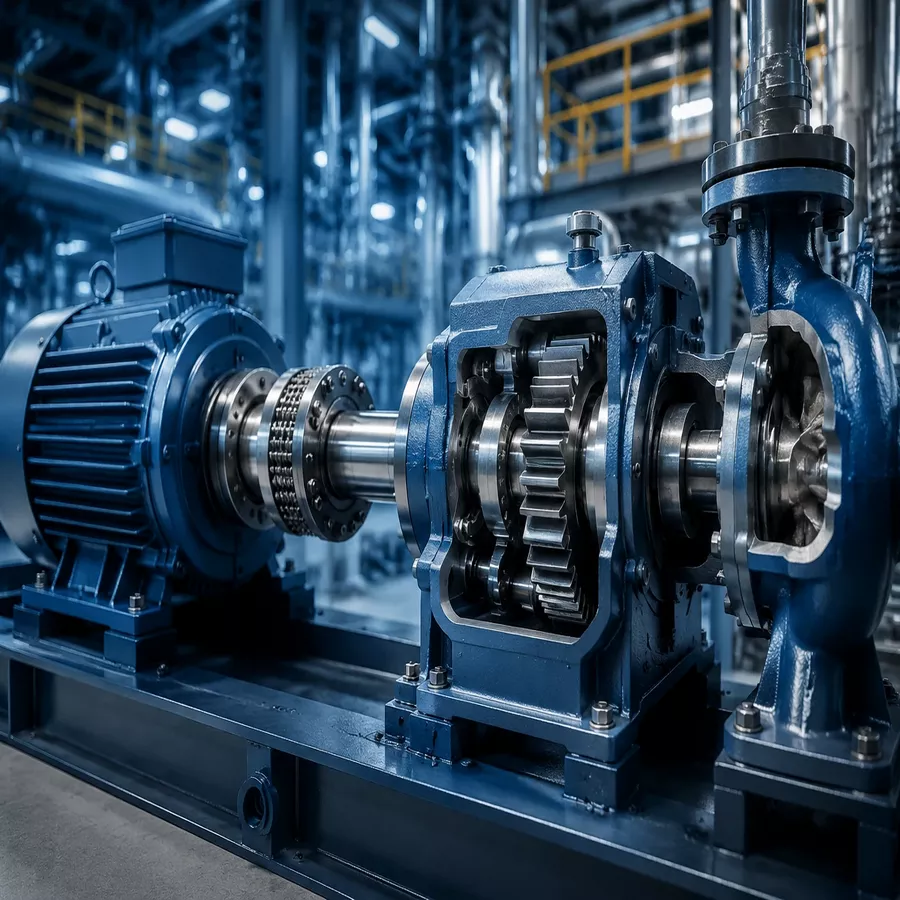
In the realm of industrial engineering, the ability to move energy from a source to a functional output is what defines the modern world. Power transmission systems are the sophisticated networks of components designed to transfer mechanical energy from a prime mover (like an electric motor or internal combustion engine) to the driven machinery.
Whether it is the massive turbines in a power plant or the precision-driven shafts in a CNC machine, understanding the fundamentals of power transmission is critical for ensuring reliability, efficiency, and longevity of rotating equipment.
1. The Physics of Power Transmission: Core Principles
At its heart, mechanical power transmission is governed by the relationship between torque, speed, and work. To analyze these systems, engineers rely on the fundamental power equation:
P=τ×ωP = \tau \times \omega
Where:
- PP represents Power (measured in Watts or Horsepower).
- τ\tau (Tau) represents Torque (the rotational force, measured in Newton-meters).
- ω\omega (Omega) represents Angular Velocity (measured in radians per second, often converted from RPM).
In most industrial applications, the primary goal of a power transmission system is to modify these variables—usually reducing speed to increase torque—to match the specific requirements of the driven load.
2. Classification of Power Transmission Systems
Power transmission is not a “one-size-fits-all” field. It is generally categorized into three main domains based on the medium used to transfer energy:
A. Mechanical Power Transmission
This is the most common form in heavy industry. It utilizes rigid or flexible components to move energy.
- Key Components: Shafts, Gears, Belts, Chains, and Couplings.
- Advantage: High efficiency and the ability to handle massive torque loads.
B. Electrical Power Transmission
Modern systems often integrate electrical components to control the mechanical output.
- Key Components: Variable Frequency Drives (VFDs), Electric Motors, and Magnetic Drives.
- Advantage: Unparalleled precision and ease of automation.
C. Fluid Power (Hydraulic & Pneumatic)
Uses pressurized liquids or gases to transmit force.
- Advantage: Extremely high power density and the ability to provide linear motion without complex gearboxes.
3. Essential Components of a Mechanical Drive Train
To understand a power transmission system, one must look at the specific hardware that keeps the shafts turning:
Shafts: The Structural Backbone
The shaft is the rotating element used to transmit power or motion. Engineers must calculate the Torsional Stress and Lateral Vibration to prevent fatigue failure. Most industrial shafts are made from high-strength alloys like AISI 4140 to withstand the rigors of continuous operation.
Couplings: The Critical Interface
Perhaps the most underestimated component, the coupling connects two shafts to transmit power while accommodating for misalignment.
- Rigid Couplings: Used when shafts are perfectly aligned.
- Flexible Couplings (Grid, Gear, Disc): Designed to protect the machinery from vibration and slight angular or parallel offsets.
Gearboxes and Speed Reducers
Gear systems allow for the precise manipulation of the torque-to-speed ratio. From Helical gears for quiet operation to Planetary gears for high-torque density, the choice of gearing defines the system’s mechanical advantage.
4. Key Engineering Challenges: Efficiency and Reliability
No power transmission system is 100% efficient. Energy is lost primarily through:
- Friction: Heat generation in bearings and gear meshes.
- Misalignment: One of the leading causes of premature bearing and seal failure.
- Hysteresis: Energy loss in elastomeric components of flexible couplings.
The Service Factor (SF): When designing these systems, engineers apply a Service Factor to account for shock loads and environmental conditions. A pump running 24/7 in a petrochemical plant will require a much higher SF than a light-duty conveyor belt.
5. The Future of Power Transmission: Smart Monitoring
We are currently entering the era of Power Transmission 4.0. Integrated sensors on couplings and bearings now allow for real-time Vibration Analysis and thermal monitoring. This shift from “break-fix” maintenance to Predictive Maintenance is revolutionizing industrial uptime.
