Introduction
Shaft alignment is one of the most critical aspects of maintaining reliable rotating machinery. In many industrial systems, equipment such as motors, pumps, compressors, turbines, and gearboxes are connected through couplings that transmit torque from a driving machine to a driven machine. For these systems to operate efficiently, the shafts of the connected machines must be properly aligned.
Even small alignment errors can lead to significant mechanical problems including excessive vibration, increased bearing loads, coupling wear, seal damage, and energy losses. Poor alignment is considered one of the most common causes of premature failure in rotating equipment.
Understanding the principles of shaft alignment and applying proper alignment techniques are essential for improving equipment reliability, reducing maintenance costs, and extending machinery lifespan.
What Is Shaft Alignment?
Shaft alignment refers to the process of adjusting the positions of two coupled rotating shafts so that their centerlines are collinear during operation. In an ideal alignment condition, both shafts rotate around the same axis without imposing unnecessary forces on bearings or couplings.
Because machines operate under dynamic conditions and thermal expansion may occur, perfect alignment is difficult to achieve. Instead, technicians aim to bring the shafts within acceptable alignment tolerances specified by equipment manufacturers.
Proper alignment ensures smooth power transmission and reduces mechanical stress on machine components.
Types of Shaft Misalignment
Shaft misalignment generally falls into three main categories.
Angular Misalignment
Angular misalignment occurs when the centerlines of two shafts intersect at an angle rather than being parallel.
In this condition:
- The shafts form a small angle at the coupling
- One side of the coupling gap becomes wider than the other
- Rotational forces create alternating stresses on the coupling and bearings
Angular misalignment often leads to vibration and accelerated wear in flexible couplings.
Parallel (Offset) Misalignment
Parallel misalignment occurs when the shafts remain parallel but are displaced laterally from each other.
Characteristics include:
- Shaft centerlines are parallel but offset
- Couplings experience lateral forces during rotation
- Bearings may experience uneven loading
Parallel misalignment can significantly reduce bearing life if not corrected.
Combined Misalignment
In real-world machinery, misalignment typically occurs as a combination of both angular and parallel misalignment. This mixed condition places complex stresses on couplings and rotating components.
Because combined misalignment is common, alignment procedures must account for both types simultaneously.
Causes of Shaft Misalignment
Several factors can lead to shaft misalignment in industrial machinery.
Common causes include:
- Improper installation during equipment setup
- Foundation settling or structural movement
- Thermal expansion during operation
- Pipe strain applied to pumps and compressors
- Mechanical wear in machine supports
- Improper maintenance or reassembly
Because machines operate under varying loads and temperatures, alignment should be periodically verified even after initial installation.
Effects of Poor Shaft Alignment
Improper shaft alignment can severely affect machinery performance and reliability.
Major consequences include:
Excessive Vibration
Misalignment generates cyclic forces during rotation, which often appear as increased vibration levels. Over time, vibration can cause fatigue damage in machine components.
Premature Bearing Failure
When shafts are misaligned, bearings experience uneven loads that accelerate wear and reduce their service life.
Coupling Damage
Couplings are designed to accommodate small alignment errors, but excessive misalignment can cause:
- Elastomer element degradation
- Grid or gear wear
- Bolt loosening
- Coupling overheating
Seal Failures
Mechanical seals used in pumps and compressors are sensitive to alignment conditions. Misalignment can cause seal face distortion and leakage.
Increased Energy Consumption
Misaligned machinery experiences higher friction and mechanical resistance, leading to reduced efficiency and higher energy consumption.
Shaft Alignment Methods
Several techniques are used in industry to measure and correct shaft alignment.
Straightedge and Feeler Gauge Method
This traditional method involves placing a straightedge across coupling hubs and using feeler gauges to measure alignment gaps.
While simple, this method is less accurate and is typically used only for rough alignment.
Dial Indicator Method
Dial indicators provide more accurate measurements by detecting small variations in shaft position as the coupling rotates.
Common dial indicator techniques include:
- Rim and face method
- Reverse dial method
Although more precise than manual methods, dial indicators require skilled technicians and careful setup.
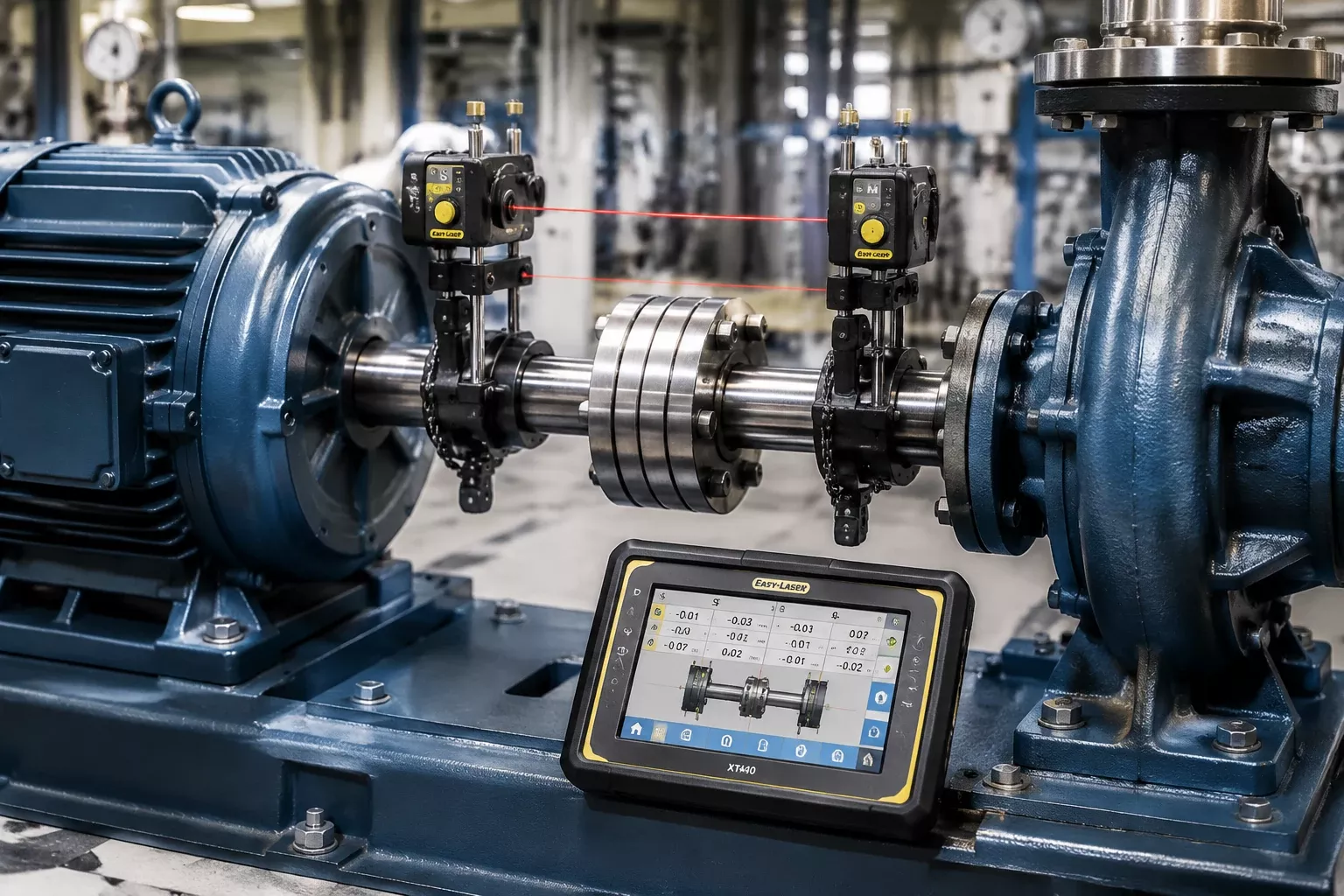
Laser Alignment Systems
Modern industries widely use laser shaft alignment tools due to their high precision and ease of use.
Laser alignment systems offer several advantages:
- High measurement accuracy
- Faster alignment procedures
- Real-time adjustment feedback
- Reduced human error
These systems can measure both angular and parallel misalignment simultaneously.
Best Practices for Shaft Alignment
Achieving proper shaft alignment requires following systematic procedures and best practices.
Perform Soft Foot Correction
Before alignment begins, technicians should check for soft foot, a condition where one or more machine feet do not sit properly on the base. Soft foot can distort machine frames and affect alignment results.
Eliminate Pipe Strain
Piping connected to pumps or compressors can apply external forces that shift equipment alignment. Pipe supports and connections should be checked to ensure that no external stress is applied to the machine.
Consider Thermal Growth
Machines often expand when operating at high temperatures. Alignment procedures should account for expected thermal expansion, particularly in turbines and large pumps.
Use Precision Tools
Modern laser alignment tools significantly improve alignment accuracy and reduce alignment time. Using proper instruments ensures reliable results.
Verify Alignment After Operation
After equipment has operated for a period of time, alignment should be rechecked to confirm that no structural movement or thermal effects have altered the alignment condition.
Benefits of Proper Shaft Alignment
Proper shaft alignment provides several operational advantages.
Key benefits include:
- Reduced vibration levels
- Extended bearing and seal life
- Lower maintenance costs
- Improved equipment efficiency
- Reduced energy consumption
- Increased reliability of rotating machinery
Organizations that prioritize alignment practices often experience significant improvements in equipment uptime and performance.
Conclusion
Shaft alignment is a fundamental requirement for the reliable operation of rotating machinery. Even minor alignment errors can cause vibration, component wear, and premature equipment failure.
By understanding the types of misalignment, identifying their causes, and applying modern alignment techniques such as laser measurement systems, industries can significantly improve machinery performance and longevity.
Implementing proper alignment procedures as part of a proactive maintenance strategy is one of the most effective ways to enhance the reliability of industrial rotating equipment.
