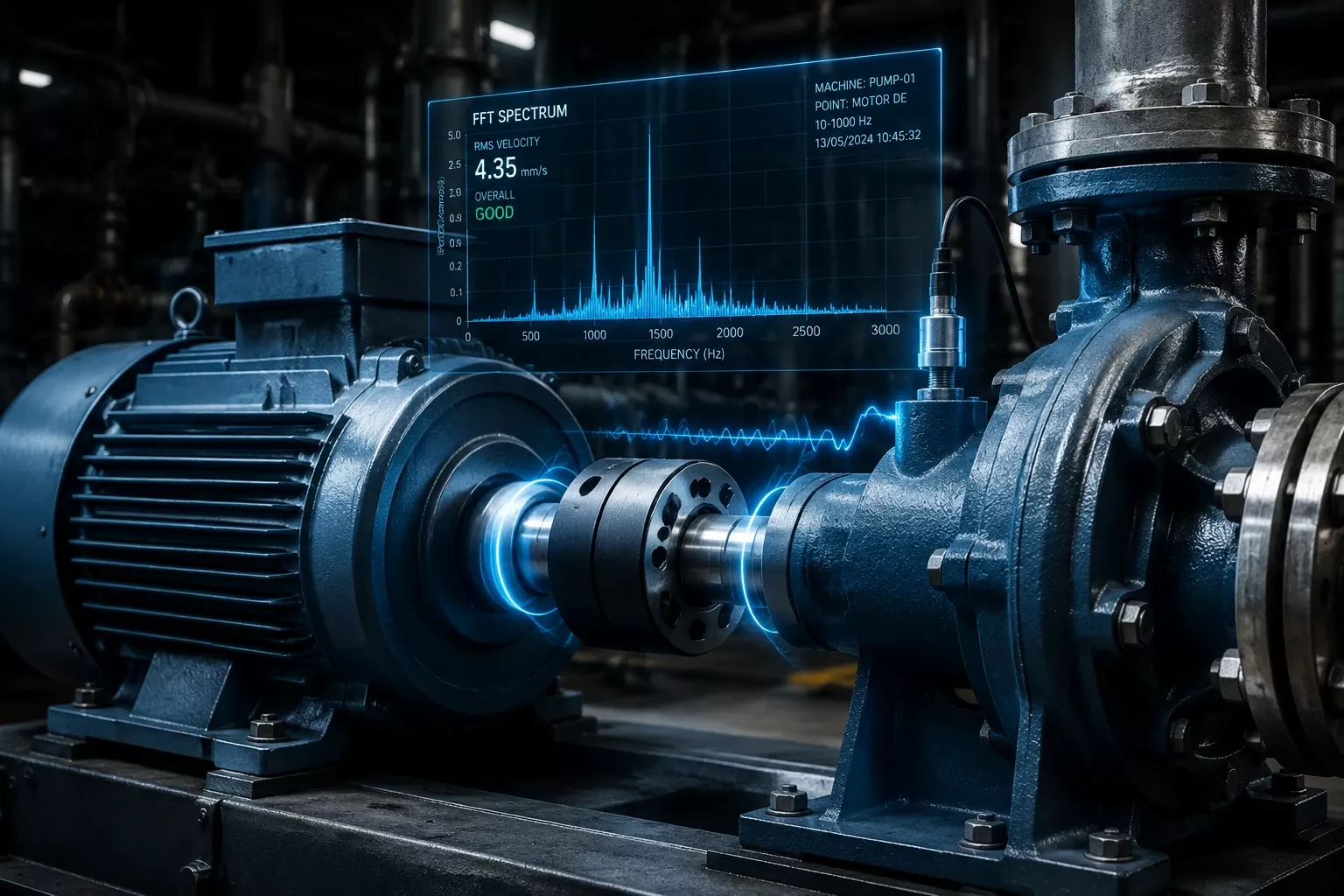
In modern industrial environments, reliability and uptime of machinery are critical to maintaining productivity and reducing operational costs. Rotating equipment such as motors, pumps, compressors, turbines, and gearboxes continuously experience dynamic forces during operation. These forces often generate vibrations, which can indicate the health condition of the machine.
Vibration Analysis is one of the most powerful predictive maintenance techniques used to monitor the condition of industrial assets. By measuring and interpreting vibration patterns, engineers can detect developing mechanical problems long before catastrophic failure occurs.
What is Vibration Analysis?
Vibration analysis is a condition monitoring technique that measures the oscillations of machinery components. These oscillations are captured using sensors called accelerometers, which convert mechanical vibration into electrical signals.
The collected data is then analyzed using specialized software to identify vibration patterns related to mechanical faults.
Every rotating machine has a normal vibration signature. When faults begin to develop, the vibration pattern changes in frequency, amplitude, or waveform, providing early warning signs of problems.
Why Vibration Analysis is Important
Implementing vibration monitoring in industrial facilities provides several key advantages:
• Early Fault Detection
Vibration analysis can detect defects such as bearing wear, imbalance, or misalignment before they cause severe damage.
• Reduced Unplanned Downtime
Maintenance teams can schedule repairs during planned shutdowns rather than reacting to sudden breakdowns.
• Lower Maintenance Costs
Predictive maintenance helps avoid unnecessary part replacements and reduces emergency repairs.
• Improved Equipment Lifespan
By identifying issues early, machines operate within safer conditions, extending component life.
• Enhanced Operational Safety
Detecting critical faults early prevents dangerous mechanical failures.
Common Machinery Problems Detected by Vibration Analysis
Vibration monitoring can reveal a wide range of mechanical issues in rotating equipment:
1. Rotor Imbalance
Imbalance occurs when the mass distribution of a rotating component is uneven. This creates centrifugal forces that increase vibration amplitude, especially at the rotational frequency (1X RPM).
2. Shaft Misalignment
Misalignment happens when the shafts of connected machines are not properly aligned. This leads to excessive vibration, heat generation, and coupling wear.
Typical vibration signatures include strong 1X and 2X rotational frequencies.
3. Bearing Defects
Rolling element bearings can develop faults such as inner race damage, outer race damage, ball defects, or cage failure. Each defect produces unique vibration frequencies known as bearing fault frequencies.
4. Mechanical Looseness
Loose bolts, worn mounts, or structural weaknesses allow excessive movement in machine components, creating irregular vibration patterns.
5. Gear Damage
Gearboxes may develop problems such as tooth wear, pitting, or broken teeth, which appear as vibration at gear mesh frequencies.
Key Vibration Parameters
When analyzing machine vibrations, several parameters are typically monitored:
Vibration Amplitude
Amplitude indicates the severity of vibration and is commonly measured in:
- mm/s (velocity)
- g (acceleration)
- microns (displacement)
Frequency
Frequency identifies the source of vibration. Different mechanical problems produce vibrations at specific frequency ranges.
Phase
Phase measurements help determine the relative motion between components, useful for diagnosing imbalance or misalignment.
Vibration Analysis Techniques
Several analytical methods are used to interpret vibration data:
Time Waveform Analysis
Shows vibration signals over time and helps identify impacts, looseness, and transient events.
FFT Spectrum Analysis
Fast Fourier Transform (FFT) converts vibration signals into the frequency domain, making it easier to identify mechanical faults.
Envelope Analysis
This technique is widely used for early detection of bearing defects.
Order Tracking
Used in variable-speed machinery to track vibration relative to rotational speed.
Tools Used in Vibration Monitoring
Industrial vibration analysis typically relies on specialized equipment:
- Accelerometers
- Portable vibration analyzers
- Online condition monitoring systems
- Data acquisition systems
- Diagnostic software platforms
Modern facilities increasingly use IoT-based vibration sensors and AI-driven predictive analytics to monitor machinery continuously.
Implementing a Vibration Monitoring Program
To successfully implement vibration analysis in industrial assets, organizations should follow structured steps:
- Identify critical machinery.
- Establish baseline vibration measurements.
- Schedule periodic monitoring or install online sensors.
- Analyze trends rather than single measurements.
- Train maintenance teams in vibration diagnostics.
A well-designed vibration monitoring program significantly improves asset reliability and maintenance efficiency.
Conclusion
Vibration analysis plays a fundamental role in predictive maintenance strategies for industrial assets. By monitoring vibration patterns in rotating equipment, maintenance teams can detect early signs of mechanical failure, optimize maintenance schedules, and extend the life of critical machinery.
As industries continue adopting smart manufacturing and Industry 4.0 technologies, vibration monitoring is becoming even more essential for ensuring reliable, efficient, and safe industrial operations.
