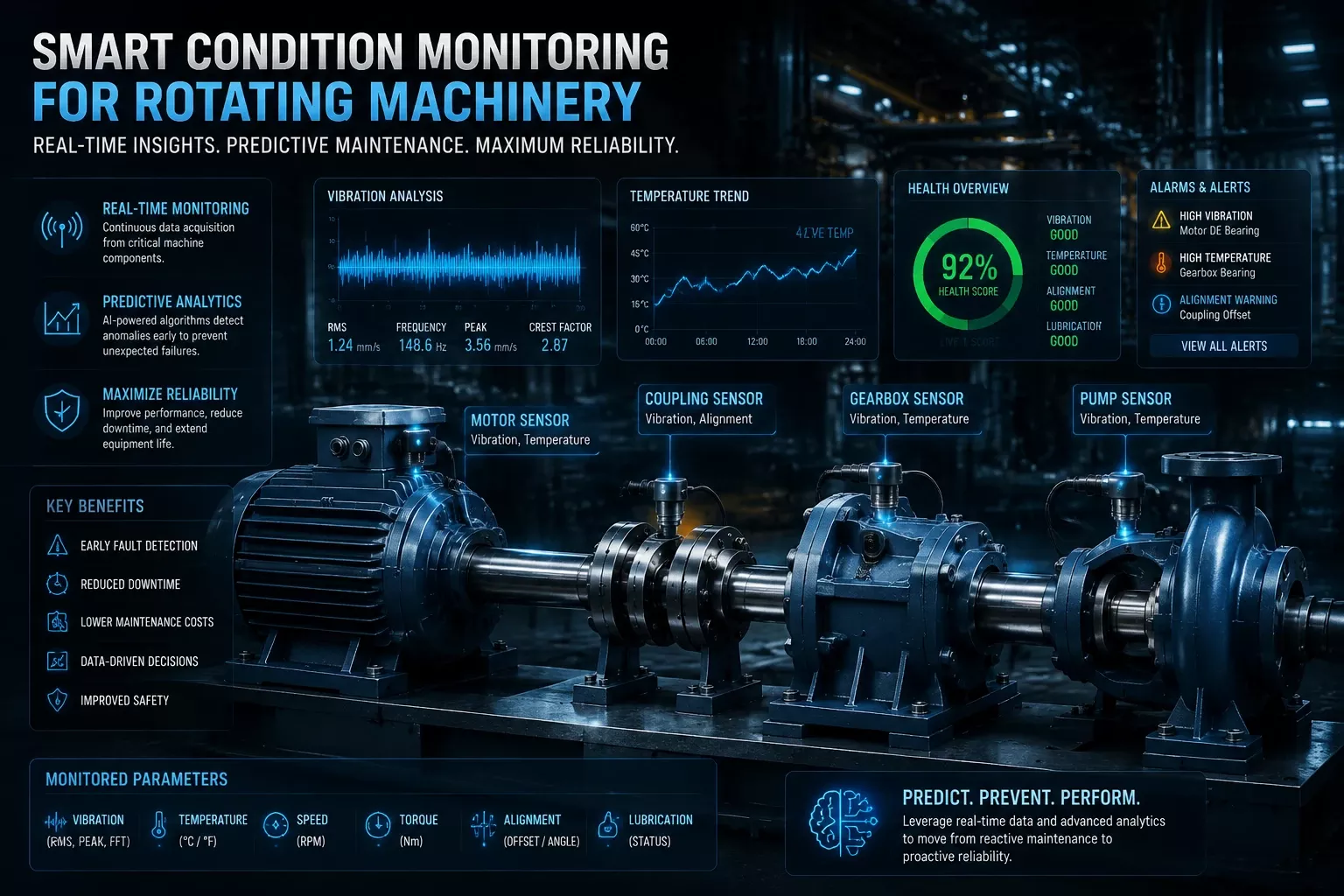
In modern industrial operations, unexpected equipment failures can lead to costly downtime, safety hazards, and production losses. To prevent these issues, many industries rely on condition monitoring techniques—a set of predictive maintenance strategies that continuously assess the health of machinery.
Condition monitoring focuses on detecting early signs of mechanical or operational problems before they develop into serious failures. By monitoring specific parameters such as vibration, temperature, lubrication condition, and acoustic signals, maintenance teams can make data‑driven decisions and perform maintenance only when it is actually required.
This approach not only reduces maintenance costs but also extends the lifespan of critical industrial assets.
What is Condition Monitoring?
Condition monitoring is a maintenance strategy that evaluates the real-time condition of equipment while it is operating. Instead of relying on fixed maintenance schedules, this method analyzes machine behavior to determine when maintenance should occur.
Sensors and monitoring systems collect operational data from machines such as:
- Electric motors
- Pumps
- Compressors
- Turbines
- Gearboxes
- Fans
This data is analyzed to detect anomalies, wear patterns, or performance degradation, allowing engineers to intervene before a failure happens.
Why Condition Monitoring is Important
Implementing condition monitoring in industrial environments provides several major advantages:
Early Fault Detection
Small defects can be detected long before they escalate into catastrophic failures.
Reduced Downtime
Maintenance can be scheduled during planned shutdowns instead of emergency repairs.
Lower Maintenance Costs
Maintenance activities become targeted and efficient rather than routine and unnecessary.
Improved Equipment Reliability
Continuous monitoring ensures machinery operates within safe operating limits.
Better Asset Management
Operators gain deeper insights into equipment performance and lifecycle.
Common Condition Monitoring Techniques
Different monitoring methods are used depending on the type of machinery and potential failure modes.
1. Vibration Analysis
Vibration analysis is one of the most widely used condition monitoring techniques for rotating equipment. It detects issues such as:
- Rotor imbalance
- Shaft misalignment
- Bearing defects
- Mechanical looseness
- Gear wear
Sensors measure vibration signals, which are analyzed using techniques such as FFT spectrum analysis and waveform analysis.
2. Thermography (Infrared Monitoring)
Infrared thermography detects abnormal heat patterns in machinery and electrical systems. Excess heat often indicates problems such as:
- Electrical overload
- Poor connections
- Bearing friction
- Insulation failure
Thermal cameras allow technicians to identify hot spots without shutting down equipment.
3. Oil Analysis
Oil analysis evaluates the condition of lubricants and identifies contaminants or wear particles within the oil.
Common parameters analyzed include:
- Viscosity
- Particle contamination
- Water content
- Metal wear particles
Oil analysis helps detect gear wear, bearing damage, and lubrication breakdown.
4. Ultrasonic Monitoring
Ultrasonic analysis detects high-frequency sound waves produced by mechanical friction, leaks, or electrical discharge.
This technique is especially useful for:
- Detecting compressed air leaks
- Identifying early bearing defects
- Monitoring steam traps
- Detecting electrical arcing
Because ultrasonic signals appear early in the failure process, this method provides very early fault detection.
5. Motor Current Analysis
Motor current signature analysis (MCSA) examines electrical signals in motors to detect mechanical and electrical problems.
It can identify issues such as:
- Broken rotor bars
- Air gap eccentricity
- Load imbalance
- Bearing problems
This technique allows monitoring without installing additional sensors on the machine.
Online vs Offline Condition Monitoring
Condition monitoring systems are generally categorized into two types:
Online Monitoring
Online systems continuously collect data from sensors installed on machinery. These systems are commonly used for critical equipment where failures would cause major operational disruptions.
Advantages include:
- Continuous real-time monitoring
- Automated alerts
- Integration with predictive maintenance platforms
Offline Monitoring
Offline monitoring uses portable diagnostic tools that technicians use periodically during inspections.
This method is suitable for less critical machinery and is often more cost-effective.
Condition Monitoring in Predictive Maintenance
Condition monitoring is a core component of predictive maintenance (PdM) strategies. Instead of performing maintenance at fixed intervals, predictive maintenance relies on actual equipment condition data.
With modern technologies such as:
- Industrial IoT sensors
- Cloud-based monitoring platforms
- Machine learning algorithms
condition monitoring systems can now predict failures weeks or even months in advance.
Conclusion
Condition monitoring techniques have become essential tools for maintaining reliable and efficient industrial operations. By continuously analyzing machine health through vibration analysis, thermography, oil analysis, ultrasonic monitoring, and electrical diagnostics, industries can significantly reduce downtime and maintenance costs.
As manufacturing moves toward smart factories and Industry 4.0, condition monitoring will continue to play a critical role in ensuring the reliability and longevity of industrial assets.
