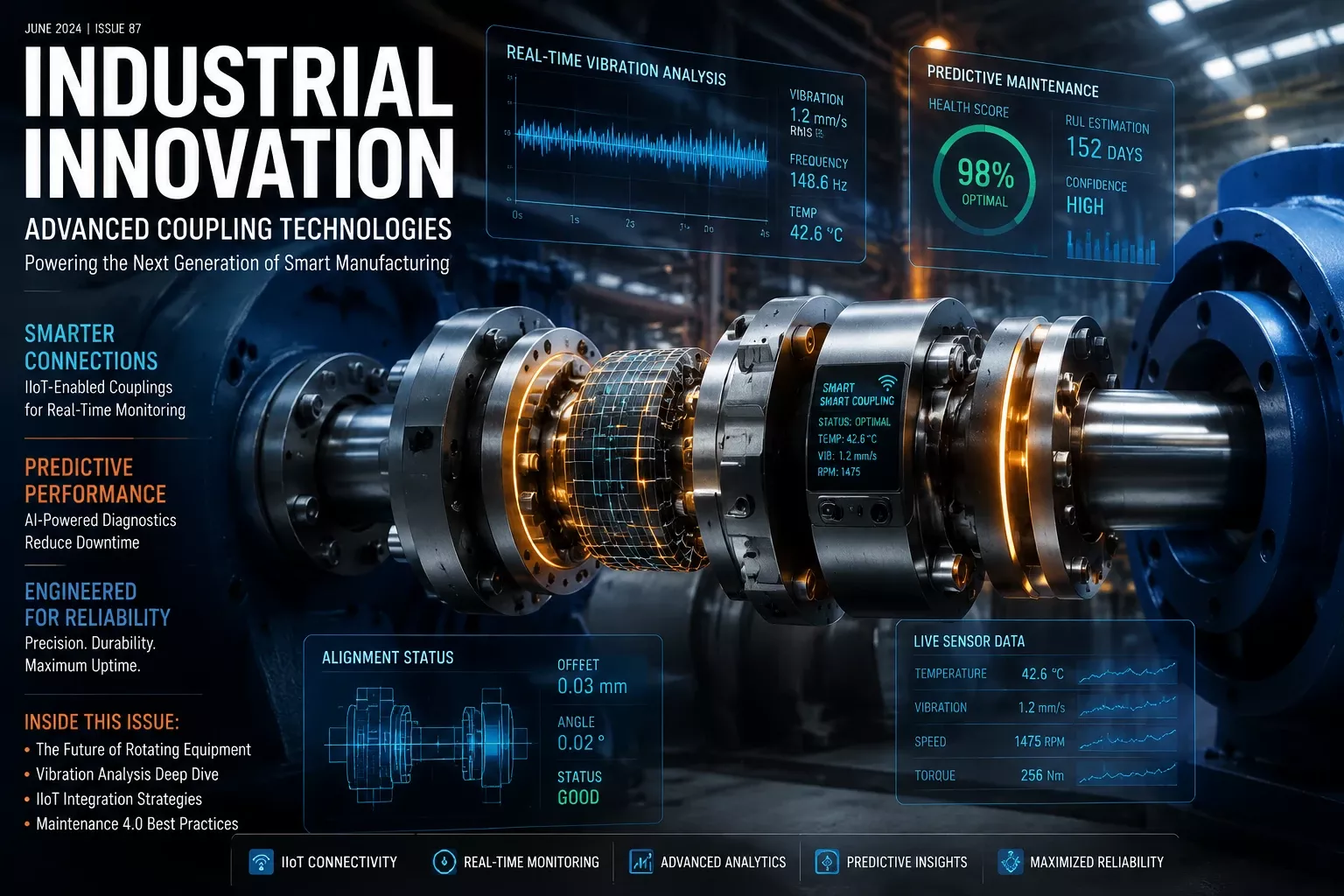
Industrial coupling technology has evolved significantly over the past decade as industries continue to demand higher efficiency, improved reliability, reduced downtime, and smarter maintenance strategies. Modern power transmission systems are no longer designed solely for torque transfer; they are now expected to contribute to predictive maintenance, vibration control, energy efficiency, and overall equipment optimization.
From advanced composite materials to intelligent condition monitoring systems, the latest innovations in industrial coupling technology are reshaping the way rotating equipment operates in sectors such as manufacturing, oil and gas, mining, energy, marine, and heavy processing industries.
This article explores the most important technological advancements currently influencing the future of industrial couplings.
Evolution of Industrial Couplings
Traditional industrial couplings were primarily designed to connect two rotating shafts while compensating for minor misalignment. While this core function remains essential, modern industrial applications have introduced new operational demands:
- Higher rotational speeds
- Increased torque density
- Reduced maintenance intervals
- Improved vibration damping
- Real-time monitoring capability
- Enhanced safety standards
As a result, coupling manufacturers have invested heavily in research and engineering to develop more intelligent, durable, and efficient coupling systems.
Smart Couplings and Condition Monitoring
One of the most significant innovations in recent years is the emergence of smart couplings equipped with embedded monitoring technologies.
These systems integrate sensors capable of measuring:
- Torque load
- Vibration levels
- Shaft misalignment
- Rotational speed
- Temperature
- Bearing condition
The collected data is transmitted to industrial monitoring platforms or plant control systems, enabling predictive maintenance strategies.
Predictive Maintenance Integration
Traditional maintenance approaches often rely on scheduled inspections or reactive repairs after failure occurs. Smart couplings allow facilities to detect early warning signs before severe mechanical damage develops.
Benefits include:
- Reduced unplanned downtime
- Lower maintenance costs
- Extended equipment lifespan
- Improved operational reliability
Industries with critical rotating machinery, such as petrochemical plants and power generation facilities, increasingly adopt intelligent coupling systems for continuous condition monitoring.
Advanced Materials in Coupling Manufacturing
Material science has become a major driver of innovation in coupling technology.
High-Strength Alloy Steels
Modern gear and grid couplings frequently use advanced alloy steels with improved fatigue resistance and enhanced mechanical strength.
These materials provide:
- Higher torque capacity
- Better wear resistance
- Improved thermal stability
Composite Materials
Some flexible couplings now incorporate lightweight composite materials, especially in high-speed applications where rotational inertia must be minimized.
Composite couplings offer:
- Reduced weight
- Corrosion resistance
- Improved vibration damping
- Lower maintenance requirements
Elastomer Advancements
Elastomeric couplings have also benefited from improved polymer technologies. Modern elastomers can withstand:
- Higher temperatures
- Chemical exposure
- UV degradation
- Dynamic cyclic loading
These improvements significantly increase coupling durability in harsh industrial environments.
High-Speed Precision Coupling Technology
Industries such as aerospace, semiconductor manufacturing, and precision automation require couplings capable of operating at extremely high rotational speeds with minimal backlash and vibration.
Modern high-speed couplings feature:
- Precision-balanced components
- Zero-backlash designs
- Optimized torsional stiffness
- Low inertia construction
Disc couplings and diaphragm couplings have seen major advancements in this area, particularly for turbine and servo-driven applications.
Maintenance-Free Coupling Designs
Another major trend is the development of maintenance-free coupling systems.
Traditional couplings, especially gear and grid types, often require periodic lubrication and inspection. Newer coupling technologies aim to eliminate these requirements.
Examples include:
- Dry-running disc couplings
- Advanced elastomeric couplings
- Sealed-for-life lubrication systems
These solutions reduce maintenance labor while improving system cleanliness and operational efficiency.
Improved Misalignment Compensation
Modern machinery often operates under dynamic conditions where thermal expansion, structural movement, and variable loads create alignment challenges.
Recent coupling innovations have improved the ability to compensate for:
- Angular misalignment
- Parallel offset
- Axial movement
Advanced flexible coupling geometries reduce stress on bearings and shafts while maintaining efficient torque transmission.
Vibration Damping and Torsional Control
Torsional vibration remains a major issue in rotating machinery systems. Excessive vibration can lead to:
- Fatigue failure
- Bearing damage
- Noise generation
- Reduced equipment life
New coupling designs incorporate advanced damping mechanisms to control vibration and absorb shock loads more effectively.
Adaptive Damping Technologies
Some advanced coupling systems now feature adaptive damping characteristics that respond dynamically to varying load conditions.
These technologies are especially valuable in:
- Marine propulsion systems
- Wind turbines
- Heavy mining equipment
- Reciprocating compressors
Digital Engineering and Simulation
Modern coupling development increasingly relies on digital engineering tools such as:
- Finite Element Analysis (FEA)
- Computational Fluid Dynamics (CFD)
- Digital twin technology
- Dynamic torsional simulation
These tools allow engineers to optimize coupling geometry, material selection, and performance characteristics before physical manufacturing begins.
As a result, modern couplings achieve:
- Higher efficiency
- Reduced weight
- Improved durability
- Better vibration behavior
Couplings for Renewable Energy Systems
The rapid growth of renewable energy has created new challenges for industrial coupling technology.
Wind Turbine Applications
Wind turbines require couplings capable of handling:
- Variable torque loads
- Extreme environmental conditions
- Continuous cyclic stress
Specialized high-capacity flexible couplings are now designed specifically for wind power drivetrains.
Solar and Hydropower Systems
Renewable energy installations also rely on advanced coupling solutions for pumps, generators, and tracking systems.
Safety Innovations in Coupling Technology
Industrial safety standards continue to evolve, leading to improved coupling protection systems.
Modern safety-related innovations include:
- Torque-limiting couplings
- Overload protection systems
- Fail-safe disconnect mechanisms
- Spark-resistant coupling designs for hazardous environments
These technologies help prevent catastrophic equipment failure and improve workplace safety.
Future Trends in Industrial Couplings
The future of industrial coupling technology will likely focus on:
- AI-assisted predictive maintenance
- Fully connected smart machinery
- Self-monitoring coupling systems
- Lightweight high-performance materials
- Increased energy efficiency
- Advanced additive manufacturing methods
As Industry 4.0 continues to expand, couplings will become increasingly integrated into intelligent industrial ecosystems.
Conclusion
Industrial coupling technology is undergoing a major transformation driven by advances in materials science, digital monitoring, predictive maintenance, and precision engineering. Modern couplings are no longer simple mechanical connectors; they are becoming intelligent components that actively contribute to machine reliability, efficiency, and operational safety.
As industries continue to pursue automation, higher performance, and reduced downtime, coupling innovations will remain essential to the evolution of industrial power transmission systems.
