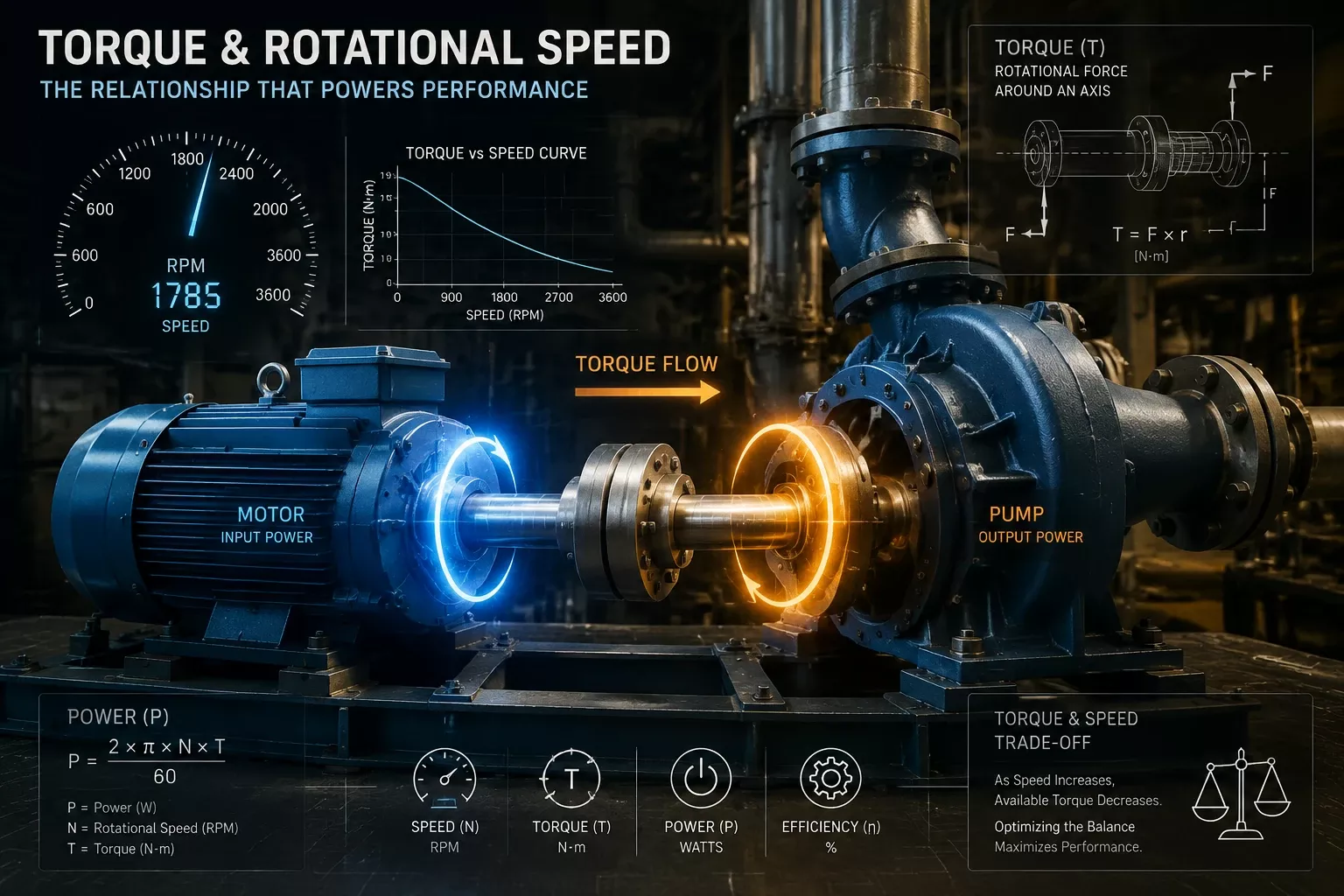
Mechanical torque and rotational speed are two of the most fundamental parameters in any rotating mechanical system. Nearly every piece of industrial equipment—motors, pumps, compressors, turbines, conveyors, and gear drives—operates based on the interaction between these two physical quantities. Understanding how torque and speed behave, and how they influence each other, is essential for engineers involved in machine design, equipment selection, troubleshooting, and system optimization.
Torque can be described as the rotational force that causes a shaft or mechanical component to turn. It represents the tendency of a force to rotate an object around an axis. Whenever a motor drives a shaft, the twisting force produced by that motor is the torque transmitted through the drivetrain. In practical terms, torque is what enables machines to overcome resistance and perform useful work. Without sufficient torque, even a high‑speed motor would not be able to move a load.
The magnitude of torque depends on both the applied force and the distance from the axis of rotation. When a force acts farther from the center of rotation, it produces a greater turning effect. This principle is why long wrenches allow mechanics to loosen tight bolts more easily than short ones. In mechanical engineering, torque is commonly measured in Newton‑meters (Nm) in the SI system, although pound‑feet (lb‑ft) and pound‑inches (lb‑in) are also used in some industries.
While torque describes the strength of the rotational force, rotational speed describes how quickly that rotation occurs. Speed is typically expressed as revolutions per minute, or RPM, which indicates how many complete rotations a shaft performs in one minute. Rotational speed is a key parameter because it determines how rapidly mechanical work is performed. For example, a pump operating at higher rotational speed can move fluid more quickly, while a high‑speed turbine can generate large amounts of energy due to rapid shaft rotation.
Industrial electric motors are designed to operate within specific speed ranges that depend on electrical frequency and motor construction. In a 60 Hz power system, common motor speeds include approximately 3600 RPM, 1800 RPM, 1200 RPM, and 900 RPM. These standardized speeds influence the design of many industrial machines because the driven equipment must operate effectively at the available motor speed or use a gearbox to adjust the speed.
Torque and speed are closely linked through the concept of mechanical power. Power represents the rate at which work is done, and in rotating systems it depends on both how much torque is applied and how fast the shaft rotates. A system producing high torque at low speed may deliver the same power as a system producing lower torque at higher speed. Because of this relationship, engineers often adjust speed and torque using gearboxes or belt drives to achieve the desired operating conditions.
For example, a gearbox commonly reduces the rotational speed of a motor while increasing the torque delivered to the driven equipment. This is particularly important in heavy industrial machinery such as conveyors, mixers, crushers, and mills, where large forces are required to move materials or process loads. By reducing speed and multiplying torque, gear systems allow relatively compact motors to perform demanding mechanical tasks.
In many industrial applications, the balance between torque and speed must be carefully controlled to ensure reliable operation. If a machine operates at too high a speed for its design, excessive vibration, heat generation, and wear may occur. Conversely, if insufficient torque is available, the machine may stall, struggle under load, or fail to start. Proper matching of torque and speed is therefore a critical step when selecting motors, couplings, and other drivetrain components.
Another important consideration is how torque and speed behave during startup and transient conditions. When a motor starts, it often produces high starting torque to overcome inertia and load resistance. As the system accelerates, torque requirements may change until the machine reaches its steady operating speed. These dynamic conditions must be considered in the design of shafts, couplings, and drive components so that they can withstand temporary torque peaks.
In rotating equipment systems, torque is transmitted through a sequence of mechanical elements. The motor generates torque, which travels through the motor shaft, passes through a coupling, and continues along the driven shaft to power the machine. Each component in this chain must be capable of handling both the torque level and the rotational speed of the system. If any component is improperly sized, it can become a weak point that leads to failure.
Couplings play a particularly important role in this process. They connect the driving and driven shafts while transmitting torque between them. At the same time, couplings must accommodate misalignment, absorb vibration, and tolerate small amounts of axial or angular movement. Because torque is the primary load carried by a coupling, understanding the torque requirements of a system is essential when selecting the appropriate coupling type and size.
The interaction between torque and speed also influences machine efficiency and energy consumption. High torque loads can increase mechanical stress and friction within bearings and gears, while excessive speeds may lead to aerodynamic losses and increased vibration. Engineers therefore aim to design systems that operate within optimal torque and speed ranges to maximize efficiency and reliability.
In modern industrial systems, variable frequency drives (VFDs) allow precise control over motor speed. By adjusting the electrical frequency supplied to the motor, operators can vary the rotational speed and, consequently, control the torque characteristics of the system. This flexibility improves energy efficiency and allows machines to operate closer to their optimal performance point.
Ultimately, torque and rotational speed form the core of mechanical power transmission. Every rotating machine depends on the proper interaction of these two parameters to function effectively. A clear understanding of how torque and speed relate to power, load requirements, and system dynamics allows engineers to design more reliable machinery, select appropriate drivetrain components, and maintain efficient industrial operations.
