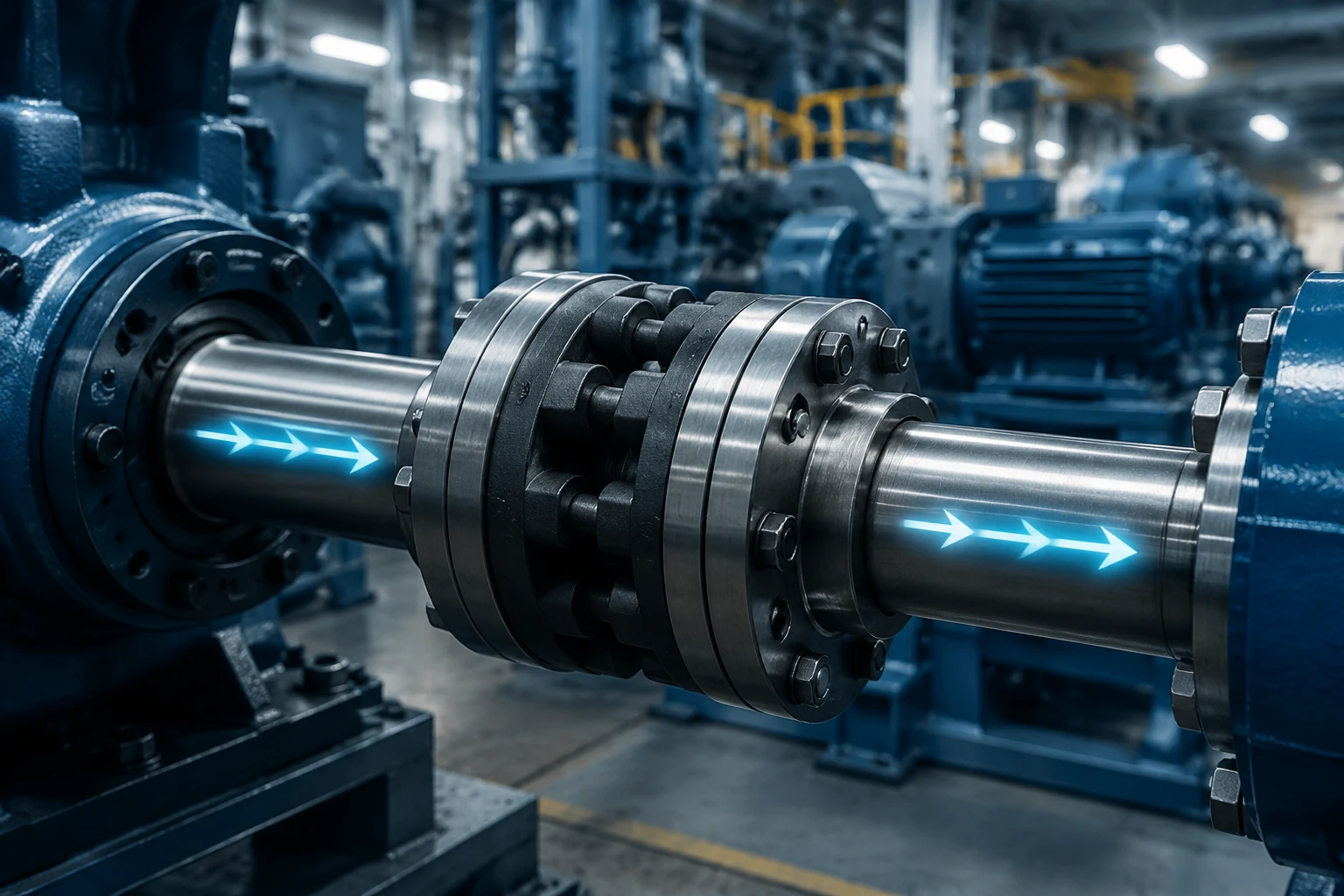
In any mechanical power transmission system, the safe and efficient transfer of energy from a driving machine to a driven machine is essential. Electric motors, turbines, engines, and other power sources generate rotational motion that must be transmitted through shafts and mechanical components to perform useful work. One of the most critical elements enabling this transfer is the shaft coupling. Couplings serve as the mechanical link that connects two rotating shafts, allowing torque to pass from the driver to the driven equipment while maintaining system stability and reliability.
Although couplings are often considered simple mechanical components, their role within rotating machinery is far more significant. They must transmit torque reliably, accommodate shaft misalignment, absorb vibration and shock loads, and protect connected equipment from excessive mechanical stress. Because of these responsibilities, couplings play a crucial role in ensuring the performance, durability, and safety of industrial power transmission systems.
Understanding Power Transmission in Rotating Machinery
Power transmission refers to the process of transferring mechanical energy from a power source to a machine that performs work. In industrial environments, this process typically begins with a prime mover, such as an electric motor, internal combustion engine, or turbine. The generated rotational energy must then be transmitted through shafts and mechanical elements to drive equipment like pumps, compressors, conveyors, mixers, or fans.
However, directly connecting two shafts without any form of flexibility or compensation would create numerous mechanical problems. Even small alignment errors between shafts can generate excessive loads, vibration, and premature wear. Additionally, rotating machinery often experiences dynamic loads, thermal expansion, and installation tolerances that make perfect alignment nearly impossible.
This is where couplings become essential. By linking two shafts together while allowing controlled flexibility, couplings enable efficient torque transmission without imposing damaging stresses on the machinery.
Primary Functions of Industrial Couplings
Torque Transmission
The most fundamental function of a coupling is transmitting torque from the driving shaft to the driven shaft. The coupling must handle the operational torque generated by the prime mover while maintaining mechanical integrity under continuous load conditions.
Industrial couplings are designed to handle a wide range of torque capacities depending on the application. Heavy‑duty couplings used in mining or steel production may transmit extremely high torque levels, while smaller couplings used in precision equipment focus on accuracy and responsiveness.
A properly selected coupling ensures that torque flows smoothly through the drivetrain without slippage or mechanical instability.
Misalignment Compensation
In real-world installations, perfectly aligned shafts are extremely rare. Misalignment may occur during installation, as a result of thermal expansion, structural deflection, or foundation movement.
There are three main types of shaft misalignment:
- Angular misalignment, where shafts intersect at an angle
- Parallel (offset) misalignment, where shaft centerlines are parallel but not aligned
- Axial misalignment, where shafts move closer together or farther apart along their axis
Couplings are specifically designed to accommodate these misalignment conditions within allowable limits. Flexible coupling designs allow controlled movement between shafts while maintaining continuous torque transmission. By absorbing these alignment deviations, couplings help prevent excessive loads on bearings, seals, and shafts.
Vibration and Shock Absorption
Industrial machinery frequently experiences dynamic forces during operation. These forces may arise from fluctuating loads, motor torque variations, reciprocating components, or sudden changes in process conditions.
Certain types of couplings incorporate flexible elements that help dampen vibration and absorb shock loads. Elastomeric couplings, grid couplings, and tire couplings are commonly used for this purpose.
By reducing the transmission of vibration through the drivetrain, couplings contribute to smoother machine operation and improved equipment lifespan. Effective vibration control also helps protect sensitive components such as bearings and mechanical seals.
Protection of Connected Equipment
Another important function of couplings is protecting machinery from overload conditions. When sudden torque spikes occur—such as during startup, emergency stops, or process disturbances—the coupling can absorb part of the mechanical stress.
Some couplings are specifically designed to act as mechanical fuses, failing in a controlled manner before more expensive equipment such as motors or gearboxes is damaged. Others include flexible elements that deform elastically under shock loads, reducing stress on the drivetrain.
This protective capability is particularly important in applications involving heavy loads or unpredictable operating conditions.
Types of Couplings Used in Power Transmission
Different coupling designs are used depending on the operational requirements of the system. Each type offers unique characteristics related to torque capacity, stiffness, flexibility, and maintenance requirements.
Rigid Couplings
Rigid couplings connect two shafts with virtually no flexibility. They provide extremely accurate torque transmission but require precise shaft alignment. Because they cannot accommodate misalignment, they are typically used only in controlled environments where alignment can be maintained.
Gear Couplings
Gear couplings use interlocking gear teeth to transmit torque while allowing some degree of misalignment. They offer very high torque capacity and are commonly used in heavy industrial applications such as steel mills, mining equipment, and large compressors.
Disc Couplings
Disc couplings use thin metallic discs to transmit torque while accommodating misalignment through elastic deformation of the discs. They are highly torsionally stiff and suitable for high‑speed applications such as turbomachinery and precision drives.
Elastomeric Couplings
Elastomeric couplings incorporate rubber or polymer elements that provide flexibility and damping. These couplings are widely used in pumps, fans, compressors, and general industrial equipment because they reduce vibration and require minimal maintenance.
Grid Couplings
Grid couplings use a spring‑like metal grid element to transmit torque while absorbing shock loads. They offer a balance between flexibility and strength and are commonly used in heavy‑duty industrial drives.
Coupling Selection and System Performance
Selecting the appropriate coupling for a power transmission system requires careful consideration of multiple factors. Engineers must evaluate torque requirements, operating speed, misalignment conditions, environmental factors, and maintenance needs.
An incorrectly selected coupling can cause serious problems such as excessive vibration, bearing failures, shaft fatigue, or unexpected downtime. Conversely, a properly selected coupling contributes to smoother power transmission, improved equipment reliability, and reduced maintenance costs.
In modern engineering practice, coupling selection often involves detailed analysis of system dynamics, including torsional vibration behavior and transient load conditions.
Couplings in Modern Industrial Systems
As industrial machinery continues to evolve toward higher speeds, greater efficiency, and increased automation, the importance of couplings in power transmission systems continues to grow. Advanced materials, improved manufacturing techniques, and digital monitoring technologies have enabled the development of more reliable and specialized coupling designs.
Some modern couplings incorporate condition monitoring features that allow engineers to track vibration levels, temperature changes, and mechanical wear. These technologies support predictive maintenance strategies, helping operators detect potential issues before equipment failure occurs.
Conclusion
Couplings play a vital role in mechanical power transmission systems by connecting rotating shafts and enabling efficient torque transfer between machines. Beyond simple shaft connection, couplings provide critical functions such as misalignment compensation, vibration damping, shock absorption, and equipment protection.
Because of their influence on system stability and reliability, couplings must be carefully selected to match the operational requirements of the machinery they connect. Understanding the role of couplings within industrial drivetrain systems allows engineers to design more efficient equipment, reduce mechanical failures, and ensure long‑term operational performance.
